Exponential
Definition
Assembly: Meta.Numerics (in Meta.Numerics.dll) Version: 4.2.0+6d77d64445f7d5d91b12e331399c4362ecb25333
public sealed class ExponentialDistribution : ContinuousDistributionPublic NotInheritable Class ExponentialDistribution
Inherits ContinuousDistributionpublic ref class ExponentialDistribution sealed : public ContinuousDistribution[<SealedAttribute>]
type ExponentialDistribution =
class
inherit ContinuousDistribution
end- Inheritance
- Object UnivariateDistribution ContinuousDistribution ExponentialDistribution
Remarks
An exponential distribution falls off exponentially in the range from zero to infinity. It is a one-parameter distribution, determined entirely by its rate of fall-off.
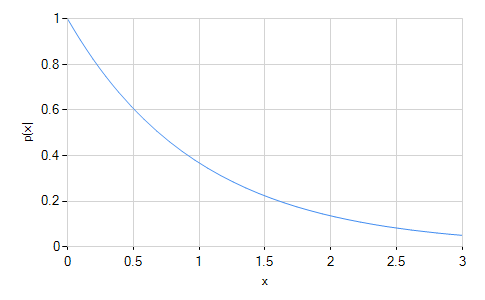
The exponential distribution describes the distribution of decay times of radioactive particles.
An exponential distribution with mean one is called a standard exponential distribution. Any exponential distribution can be converted to a standard exponential by re-parameterizing the data into "fractions of the mean," i.e. z = x / μ.

Processes resulting in events that are exponentially distributed in time are said to be "ageless" because the hazard function of the exponential distribution is constant. The Weibull distribution (WeibullDistribution) is a generalization of the exponential distribution for which the hazard function changes (usually by increasing) with time.
Constructors
| ExponentialDistribution | Initializes a new standard exponential distribution. |
| ExponentialDistribution(Double) | Initializes a new exponential distribution with the given mean. |
Properties
| ExcessKurtosis |
Gets the excess kurtosis of the distribution.
(Overrides UnivariateDistributionExcessKurtosis) |
| Mean |
Gets the mean of the distribution.
(Overrides UnivariateDistributionMean) |
| Median |
Gets the median of the distribution.
(Overrides ContinuousDistributionMedian) |
| Skewness |
Gets the skewness of the distribution.
(Overrides UnivariateDistributionSkewness) |
| StandardDeviation |
Gets the standard deviation of the distribution.
(Overrides UnivariateDistributionStandardDeviation) |
| Support |
Gets the interval over which the distribution is non-vanishing.
(Overrides ContinuousDistributionSupport) |
| Variance |
Gets the variance of the distribution.
(Inherited from UnivariateDistribution) |
Methods
| CentralMoment |
Computes a central moment of the distribution.
(Overrides ContinuousDistributionCentralMoment(Int32)) |
| Cumulant |
Computes a cumulant of the distribution.
(Overrides UnivariateDistributionCumulant(Int32)) |
| Equals | Determines whether the specified object is equal to the current object. (Inherited from Object) |
| ExpectationValue |
Computes the expectation value of the given function.
(Inherited from ContinuousDistribution) |
| FitToSample | Computes the exponential distribution that best fits the given sample. |
| GetHashCode | Serves as the default hash function. (Inherited from Object) |
| GetRandomValue |
Generates a random variate.
(Overrides ContinuousDistributionGetRandomValue(Random)) |
| GetRandomValues |
Generates the given number of random variates.
(Inherited from ContinuousDistribution) |
| GetType | Gets the Type of the current instance. (Inherited from Object) |
| Hazard |
Computes the hazard function.
(Overrides ContinuousDistributionHazard(Double)) |
| InverseLeftProbability |
Returns the point at which the cumulative distribution function attains a given value.
(Overrides ContinuousDistributionInverseLeftProbability(Double)) |
| InverseRightProbability |
Returns the point at which the right probability function attains the given value.
(Overrides ContinuousDistributionInverseRightProbability(Double)) |
| LeftProbability |
Returns the cumulative probability to the left of (below) the given point.
(Overrides ContinuousDistributionLeftProbability(Double)) |
| ProbabilityDensity |
Returns the probability density at the given point.
(Overrides ContinuousDistributionProbabilityDensity(Double)) |
| RawMoment |
Computes a raw moment of the distribution.
(Overrides ContinuousDistributionRawMoment(Int32)) |
| RightProbability |
Returns the cumulative probability to the right of (above) the given point.
(Overrides ContinuousDistributionRightProbability(Double)) |
| ToString | Returns a string that represents the current object. (Inherited from Object) |